The Role of Fiber in Modern Poultry Diets

Addressing the Fiber Issue
U.S. broiler diets are predominantly corn and soybean meal-based formulations with limited fermentable fiber content. These diets are optimized for energy and amino acid density, with fiber content being a secondary consideration even though research in this area is receiving more attention. This practice reflects a long-standing view nutritionists have of fiber as an antinutritional factor; with its presence having negative consequences for nutrient digestibility and dietary energy density. Our understanding of fiber, however, is reframing how we approach dietary fiber as research continues to reveal the potential benefits fiber may provide. Dietary fiber is increasingly being recognized for its potential functional roles in gut health, nutrient absorption, and microbial ecology, rather than purely being treated as an inert or detrimental component (Evans et al., 2026). Fiber is a complex topic, but breaking it down, literally and figuratively, helps clarify where its value may lie.
Limitations of Fiber
First, understanding the limitations of fiber utilization is important to assessing its potential value. There are several aspects that contribute to previous assumptions, such as:
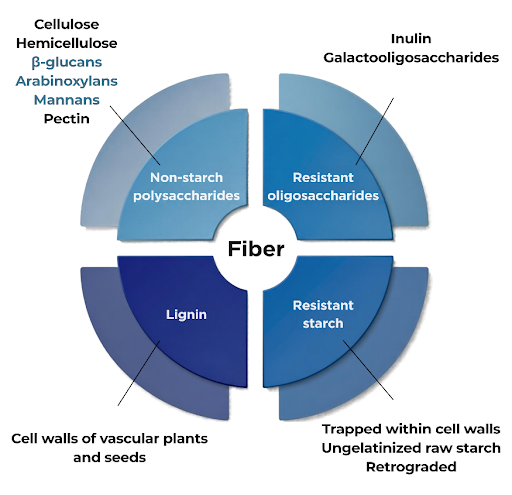
Composition and solubility. Fiber encompasses a broad range of constituents, each with unique structures and characteristics. It consists of four sub-groups: non-starch polysaccharides (NSPs), resistant oligosaccharides, resistant starch, and lignin (Su et al., 2022; Figure 1). One of the more critical fiber components in broiler diets are NSPs, which typically make up 85 to 90 % of the total dietary fiber in a US based diet. Under the category of NSPs, is cellulose, hemicellulose (which is a catch all for components such as arabinoxylans and β-glucans in cereals, and arabinans, xyloglucans, etc in oilseed meals), and pectin. Components such as lignin and resistant starch stand alone and are generally indigestible fractions of fiber. As such, the intricacies of fiber make it a challenging feedstuff to approach when formulating a diet.
Q3 Graph 1
Figure 1. Components of dietary fiber and examples within each category. Figure adapted from Su et al., 2022.
The traditional concerns of utilizing fiber in poultry diets, however, remain relevant because poultry lack the endogenous enzymes required to break down NSPs (Raza et al., 2019). These antinutritional properties manifest through several distinct mechanisms that impair digestion and bird performance:
- Soluble fiber & impaired nutrient absorption: soluble NSs like arabinoxylans and β-glucans swell and absorb water resulting in increased digesta viscosity. This slows down the passage rate, as well as prevents enzyme access to substrates, thus reducing nutrient absorption and subsequent animal performance (Sadeghi et al., 2015).
- Insoluble fiber & digestible nutrients: insoluble fiber (e.g. cellulose and hemicellulose) encapsulate digestible nutrients with the cell walls such as starch, proteins and fats.
Understanding raw material fiber composition is a key component of utilizing fiber successfully to support bird health and performance; specifically, formulating diets based on soluble and insoluble dietary fiber represents the first step in moving to functional fiber use in diets today.
Solubility is central to understanding how fiber behaves within the gastrointestinal tract. Because the ceca are the primary site of fermentation in the chicken and preferentially receive soluble material, the soluble fiber content of the diet is especially relevant. However, balancing soluble and insoluble fractions remains a challenge: an excess of insoluble fiber reduces dietary energy density and nutrient absorption, whereas excessive soluble fiber alters passage rate and may favor pathogen proliferation (J. Tejeda and K. Kim, 2021).
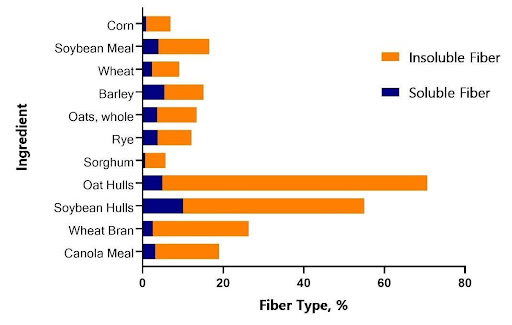
Variability of fiber. Not only is fiber complex in nature, but its content varies widely among raw materials, exposing the bird to highly diverse dietary fiber profiles (Figure 2). For nutritionists characterizing these differences is essential during formulation. Wheat, barley, oats, and triticale; although not commonly used in US diets, are rich in high molecular weight soluble NSPs that induce high intestinal viscosity. Conversely, corn is low in soluble fiber and creates little viscosity while soybean meal contains a substantial amount of soluble fiber that is neither highly viscous nor entirely fermentable. This variability complicates standardized formulation strategies and ingredient sourcing decisions, adding more complexity to dietary fiber use.
Q3 Graph 2
Figure 1. Fiber composition of various common feedstuffs. Data from Menegat et al., 2019.
Taking together, structure, antinutritive considerations, solubility and substrate variability help to explain why dietary fiber has historically been minimized. Today, however, the emergence of feed technologies offers practical solutions to unlock and utilize these fermentable fractions.
Modern Approaches for Fiber Functionality
The practical solutions to unlock the value of dietary fiber include: enzymes, prebiotics, and stimbiotics. Although each work differently, collectively they tackle the same underlying challenge of making fiber usable.
Enzymes. Exogenous enzymes hydrolyze specific fiber fractions generating a range of soluble polysaccharides and oligosaccharides that serve as a substrate for fermentation in the ceca. Essentially, enzyme supplementation provides two benefits: first, it hydrolyzes insoluble fiber to generate soluble fractions, thereby converting a dietary diluent into a valuable fermentation substrate; second, it alleviates the anti-nutritive burden posed by viscous soluble fiber, which simultaneously generates more fermentable substrate for gut bacteria and improves overall nutrient digestibility.
Prebiotics. A prebiotic is defined as a fermented substrate that is selectively utilized by the host microorganism and grants health benefit. Common examples of prebiotics used in poultry diets are fructo-oligosaccharides (FOS), mannan-oligosaccharides (MOS) and xylo-oligosaccharides (XOS). Fermentable oligosaccharides such as XOS serve as substrates for the production of volatile fatty acids (VFAs), which provide usable energy for the bird. Prebiotics are fed in large quantities (several pounds per ton or greater) to contribute directly and significantly to the fermentable fiber pool. The key distinction from enzyme action is that the prebiotic effect depends on the quantity and fermentability of the substrate itself, rather than on enzymatic breakdown.
Stimbiotics. Stimbiotics represent a unique class of feed additives designed to stimulate fiber-fermenting microbial activity. Unlike prebiotics, they are included at much lower application rates because they do not function as a substantial fermentation substrate. Rather than supplying fermentable substrate, stimbiotics signal the resident gut microbiota to increase their own production of fiber-degrading enzymes. This action enhances the utilization of the fiber already present in the diet, ultimately driving the production of VFAs like butyrate, which fundamentally supports gut functionality.
Table 1. Comparison of fiber technologies.
| Mechanism | Acts On | |
|---|---|---|
| Enzymes | Hydrolyze specific fiber fractions | Structural fiber components, increasing supply of soluble fiber |
| Prebiotics | Supply significant quantities of fermentable substrate directly | Select microbial populations |
| Stimbiotics | Stimulate fiber-degrading microbial activity | Resident fiber-fermenting bacteria |
Summary and Looking Forward
Historically, fiber has not been a key component of broiler diets due to its complexity, wide variation across ingredients, and significant nutritional challenges it can contribute to in the animal. While the use of dietary fiber has historically carried a negative reputation in poultry diets, continued research and advances in nutritional tools are helping reframe its role in modern poultry nutrition. Feed technologies such as enzymes, prebiotics, and stimbiotics are shifting the conversation from minimizing fiber inclusion to actively leveraging specific fiber fractions. Within this evolving landscape, XOS have gained considerable attention for their potential role in enhancing fiber utilization, with emerging research suggesting that characteristics like chain length may influence their functionality throughout the gastrointestinal tract. In our next newsletter, we’ll take a closer look at how XOS fit into this story and uncover what recent research reveals.
References
Evans, C., A. Petry, T. Johnson, M. H. Kogut, C. L. Walk, and T. York. 2026. A NEW FOCUS ON FIBER. Poult. Sci. 105:106863. doi:10.1016/j.psj.2026.106863.
J. Tejeda, O., and W. K. Kim. 2021. Role of Dietary Fiber in Poultry Nutrition. Animals. 11:461. doi:10.3390/ani11020461.
Menegat, M. B., R. D. Goodband, J. M. DeRouchey, M. D. Tokach, J. C. Woodworth, and S. S. Dritz. 2019. Kansas State University swine nutrition guide: Fiber in nursery diets. Kansas State Univ., Manhattan, KS.
https://www.asi.k-state.edu/extension/swine/swinenutritionguide/pdf/KSU%20Fiber%20in%20Nursery%20Diets%20fact%20sheet.pdf.
Raza, A., S. Bashir, and R. Tabassum. 2019. An update on carbohydrases: growth performance and intestinal health of poultry. Heliyon. 5. doi:10.1016/j.heliyon.2019.e01437.
Sadeghi, A., M. Toghyani, and A. Gheisari. 2015. Effect of various fiber types and choice feeding of fiber on performance, gut development, humoral immunity, and fiber preference in broiler chicks. Poult. Sci. 94:2734–2743. doi:10.3382/ps/pev292.
Su, G., X. Qin, C. Yang, A. Sabatino, J. T. Kelly, C. M. Avesani, J. J. Carrero, and an official body of the E. on behalf of the ERA European Renal Nutrition Working Group. 2022. Fiber intake and health in people with chronic kidney disease. Clin. Kidney J. 15:213–225. doi:10.1093/ckj/sfab169.