Redox resilience: battling oxidative stress in modern swine production
What is oxidative stress?
The U.S. swine industry is driven by efficiency and optimization of animal performance. Today’s hog production, with technological advances in management, is well managed and pig welfare is paramount. Even with these advances, stress on the animal can often occur throughout their lifecycle. Stressors can be both internally and externally derived, such as disease outbreaks (i.e. PRRSv and PED), heat stress, diet changes, transportation, etc. These scenarios can potentially lead to increased oxidative stress, which can have a negative impact on reproductive and growth performance. Oxidative stress can be simply defined as an imbalance of free radicals, or reactive oxygen species (ROS), that outweigh the antioxidant capacity of the body. Although free radicals are normal byproducts of metabolism, it becomes problematic when their production exceeds the capacity for cells to combat oxidative damage. When damage occurs at the cellular level, it may lead to poor intestinal and reproductive health that presents as pregnancy complications, reduced growth, feed efficiency, and immunosuppression.
Impact on sows
Late gestation and lactation are crucial periods for sows, characterized by increasing metabolic activity and oxygen demands. Genetic selection and improved management strategies have allowed for an increase in sow prolificacy in recent years, with 1.9 total pigs more born per litter from 2016 (13.95) to 2023 (15.84) as reported by the PigCHAMP benchmarking summaries (PigCHAMP.com, 2023). Consequently, the metabolic burden on sows has been elevated to meet demands of larger litter sizes with limited changes in dietary vitamin and trace mineral levels. Research comparing sows with an average of 11.5 piglets versus larger litters (average 15.9 piglets) shows the impact that litter size can have on oxidative stress, with sows rearing large litters having higher levels of salivary H2O2 and advanced oxidative protein products (AOPP) during late gestation and early lactation (Figure 1; (Lee et al., 2023).
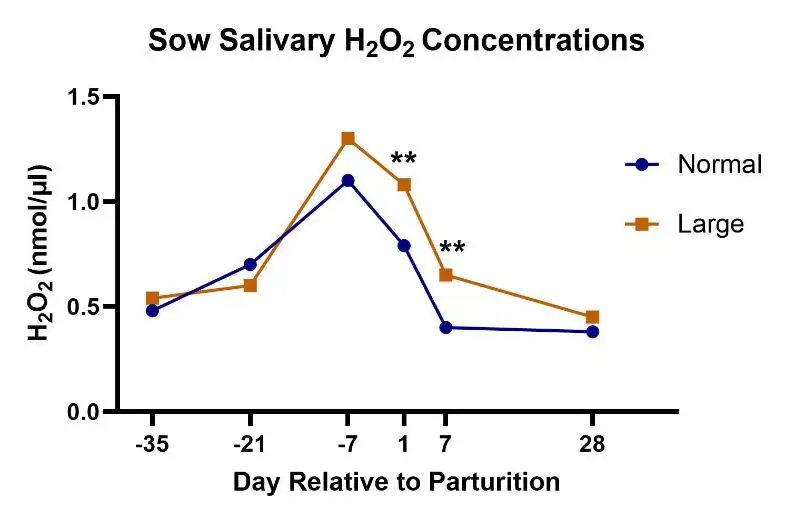
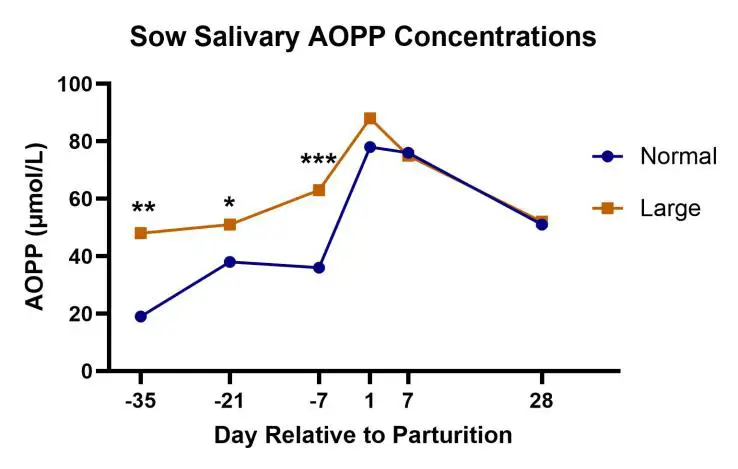
Figure 1. Data adapted from Lee et al., 2023. Graphs depict salivary H2O2 and AOPP concentrations in sows rearing normal and large litter sizes during late gestation and early lactation. Asterisks denote significant differences declared by the authors at P < 0.10 (*), P < 0.05 (**), and P < 0.01 (***).
During late gestation, a sow’s metabolic activity increases to support placental vascularization, rapid fetal growth, and mammary development. In lactation, oxidative stress and ROS production are further amplified due to the physiological demands of colostrogenesis and milk production. The level of oxidative stress in sows can be further exacerbated by disease challenges such as PRRS or PED. Huang et al. (2020) used testes of male piglets as a model to demonstrate that infection with PRRS resulted in an increase in oxidative stress markers such as H2O2 and malondialdehyde (MDA). This response is potentially in part due to the effectiveness of PRRS at impairing the Nrf2 antioxidant pathway, which regulates the expression of antioxidant genes (Wang et al., 2025). By inhibiting this pathway, the animal’s ability to combat excess ROS is greatly reduced, thus contributing to oxidative stress at the cellular level.
Additionally, environmental factors, such as heat stress, raise metabolic and oxygen demands, limit mitochondrial respiration, and activate inflammatory and gut-derived pathways that collectively increase ROS production while depleting antioxidant defenses, leading to systemic oxidative stress and tissue damage. Data from Zhao and Kim (2020) highlighted that in sows subjected to higher thermal environments, the level of oxidation, as measured by MDA, was substantially increased throughout gestation and lactation (Figure 2; Zhao and Kim, 2020).
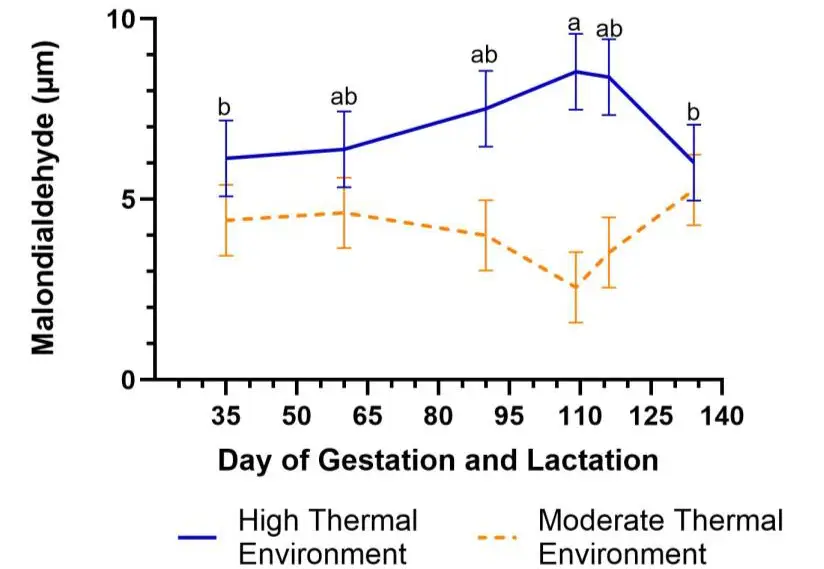
Figure 2. Data adapted from Zhao and Kim, 2020. Graph depicts MDA concentrations in sows subjected to moderate or high thermal environments throughout gestation and lactation.
Increased MDA concentrations are a direct result of oxidation of polyunsaturated fatty acids caused by an excess of ROS that antioxidants have failed to neutralize, which opens the door for downstream effects on animal performance. When ROS outweighs the antioxidant capacity of the sow, they can negatively impact placental endothelial cells to reduce blood flow and nutrient transport to their fetuses. This suboptimal environment caused by high levels of maternal oxidative stress can then potentially lead to a reduction in reproductive performance, as well as sow longevity and a longer period of disease stress.
Nutritional management strategies
There are several potential ways to mitigate the negative effects of oxidative stress, but supplementation of antioxidants is among the most beneficial and practical. Vitamin E, which is commonly included in rations, acts as a bio essential vitamin and radical scavenger (i.e. electron donor) to effectively provide defense against oxidants and thereby reduce oxidative stress. Vitamin E is a lipid-soluble antioxidant, meaning it typically associates with the phospholipids found in cell membranes. An additional dietary component may also be vitamin C, which is a ‘hydrophilic’ antioxidant, meaning it is soluble and acts in the cytosol and other fluid-based systems such as saliva. Coupled with vitamin E, it helps provide an antioxidant system to counteract ROS in the cytosol as well as protecting mitochondria from oxidative damage through normal metabolic functions.
Polyphenols follow a similar mode of action; however, what makes them unique compared to vitamin E is the location relative to the cell that they are protecting. Depending on product composition, a blend of polyphenols can be both fat- and water-soluble, so they can be absorbed directly into cells and neutralize excess ROS from within, where most of the damage occurs. Furthermore, it has been shown that specific polyphenols can upregulate enzymes (e.g. SOD) that help mitigate oxidation in cells (Obeme-Nmom et al., 2024). This is associated by the polyphenols indirectly stimulating the Nrf2 pathway in the cytoplasm where vitamin E is not functioning. By including polyphenols in the diet, there are opportunities to provide an economical solution to help spare both Vitamins E and C as well as regenerate Vitamin E for their targeted support of metabolic functions while impacting oxidative status through the Nrf2 pathway directly.
Initial research in sows supports the use of elevated use of polyphenols in improving antioxidant status and performance. Elife®, a blend of polyphenols formulated to target both fat- and water-soluble functionalities, was included at a rate of 2 lb/ton in sow treatment diets during the late gestation and lactation period. Control animals were fed the same base diet with no polyphenols. Vitamin E levels (100 IU/kg) were maintained at a consistent level in both diets. The outcome of this evaluation showed the following responses in sows receiving Elife® compared to controls:
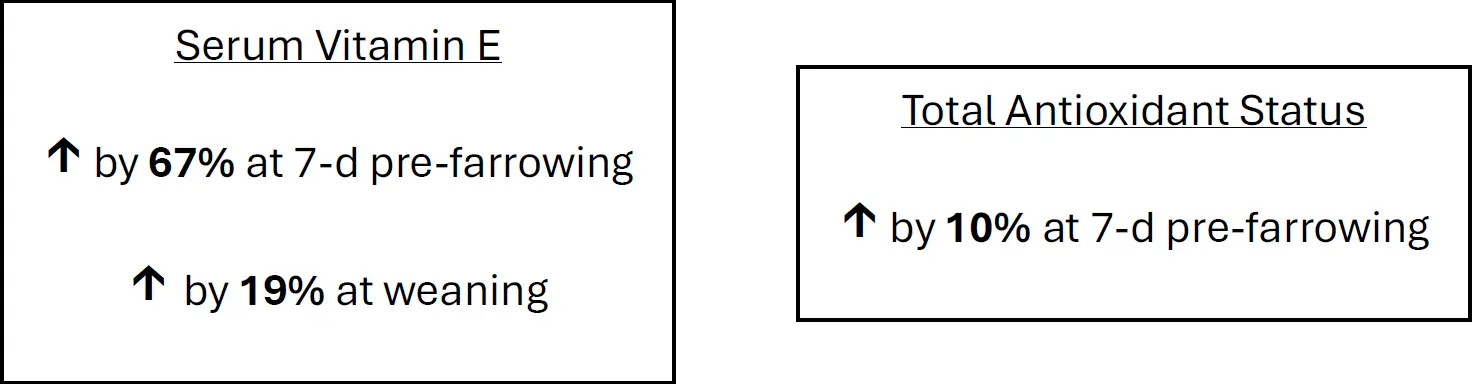
This translated into improved reproductive performance with a greater litter weaning weight (a combination of more pigs born alive and more pigs weaned) as well as an extra pig produced on the next cycle through.
Previous research in addition to this trial suggests that nutritional management using antioxidants, such as a blend of polyphenols, may be a useful tool for regulating antioxidant status of a sow during periods of heightened stress. Whether the goal is to minimize oxidative stress during periods of elevated metabolic demand, combat diseases such as PRRS, or target heat stress in the warm summer months, a blend of polyphenols such as Elife® can potentially provide an opportunity for improving animal performance while also typically being a cost-effective solution.
References
Benchmarking Summaries | Swine Management Software | PigCHAMP.com. Available from: https://www.pigchamp.com/benchmarking/benchmarking-summaries. Accessed March 2026.
Huang, B., F. Li, D. You, L. Deng, T. Xu, S. Lai, Y. Ai, J. Huang, Y. Zhou, L. Ge, X. Zeng, Z. Xu, and L. Zhu. Porcine reproductive and respiratory syndrome virus infects the reproductive system of male piglets and impairs development of the blood–testis barrier. Virulence. 15:2384564. doi:10.1080/21505594.2024.2384564.
Lee, J., H. Shin, J. Jo, G. Lee, and J. Yun. 2023. Large litter size increases oxidative stress and adversely affects nest-building behavior and litter characteristics in primiparous sows. Front Vet Sci. 10:1219572. doi:10.3389/fvets.2023.1219572.
Obeme-Nmom, J. I., R. O. Abioye, S. S. R. Flores, and C. C. Udenigwe. 2024. Regulation of redox enzymes by nutraceuticals: a review of the roles of antioxidant polyphenols and peptides. Food Funct. 15:10956–10980. doi:10.1039/D4FO03549F.
Wang, F., F. M. Amona, Y. Pang, Q. Zhang, Y. Liang, Xiaohan Chen, Y. Ke, J. Chen, C. Song, Y. Wang, Z. Li, C. Zhang, X. Fang, and Xi Chen. 2025. Porcine reproductive and respiratory syndrome virus nsp5 inhibits the activation of the Nrf2/HO-1 pathway by targeting p62 to antagonize its antiviral activity. Journal of Virology. 99:e01585-24. doi:10.1128/jvi.01585-24.
Zhao, Y., and S. W. Kim. 2020. Oxidative stress status and reproductive performance of sows during gestation and lactation under different thermal environments. Asian-Australas J Anim Sci. 33:722–731. doi:10.5713/ajas.19.0334.